
Hot Products
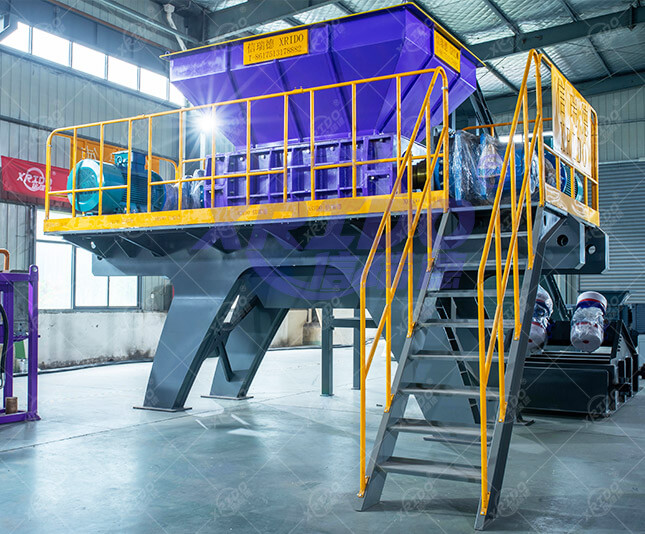
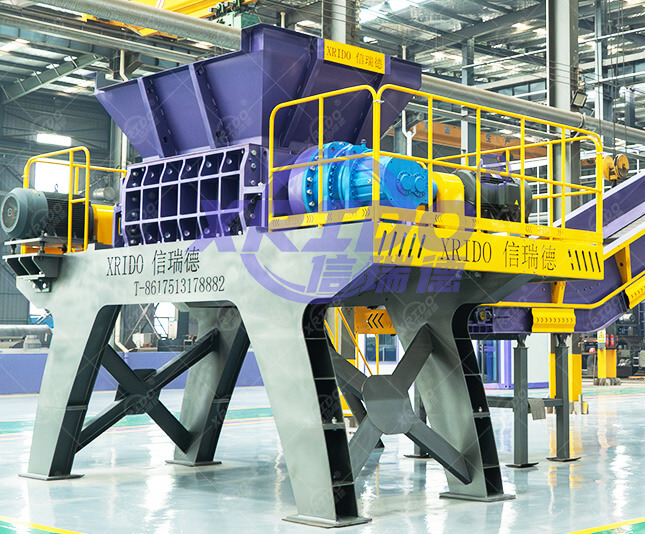
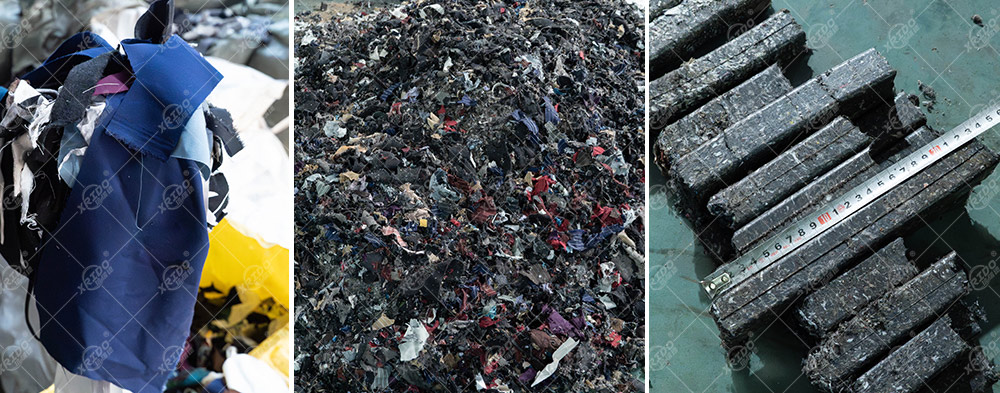
Xrido RDF Production Machine for Waste Textiles
RDF Equipment for producing Refuse Derived Fuel (RDF) from waste textiles refers to a core equipment system that converts hard-to-recycle waste textiles (such as used clothes, home textile scraps, industrial textile waste, etc.) into standardized, high-calorific-value fuel through physical and mechanical processes. Its core objective is to address the problems of “difficulty in recycling, high disposal costs and heavy pollution” associated with waste textiles, while achieving the goals of “solid waste reduction and resource utilization for energy generation”.
Core Processes and Corresponding Equipment for RDF Production from Waste Textiles Waste textiles have complex compositions (including cotton, polyester, nylon, spandex and other fibers, with some containing metal buckles, zippers, dyes and other impurities). To produce RDF, five core processes are required: **pretreatment → shredding → separation → densification → drying (optional)**. Each process corresponds to dedicated equipment, as detailed below:
| Process Stage | Core Function | Key Equipment | Equipment Features and Functions |
| Pretreatment | Remove large impurities and loosen materials to prepare for subsequent shredding | 1. Manual sorting station 2. Vibrating feeder 3. Magnetic separator | – Manual sorting station: Manually remove hard impurities such as metal buckles, zippers and leather accessories (to avoid damaging shredding equipment); – Vibrating feeder: Uniformly convey waste textiles to prevent material clogging; – Magnetic separator: Secondarily remove ferromagnetic impurities (e.g., metal wires, buttons) from materials to improve subsequent separation accuracy. |
| Shredding | Shred large, fluffy textiles into uniform fibrous or fragmentary materials | 1. Dual-shaft shear shredder 2. Hammer mill (optional) | – Dual-shaft shear shredder (core equipment): Adopts a “low-speed, high-torque” shear cutter head, capable of shredding high-toughness textiles (e.g., polyester fabrics) without fiber tangling, resulting in shredded material with a particle size of 5–20 mm; – Hammer mill: If a finer particle size is required (e.g., for blended fuel), it can be used as a follow-up unit to further refine materials via high-speed rotating hammers. |
| Separation | Separate non-fibrous impurities (e.g., plastic accessories, rubber, residual dye lumps) to improve fuel purity | 1. Air separator 2. Electrostatic separator 3. Density separator | – Air separator: Separate lightweight fibers from heavy impurities (e.g., plastic flakes) by utilizing the difference in air buoyancy; – Electrostatic separator: Separate different components based on the charge difference between polyester (chemical fiber) and cotton fibers (enabling adjustable fuel composition ratios as needed); – Density separator: Separate impurities denser than fibers (e.g., glass beads, small metal particles) using water or heavy media. |
| Densification | Compress shredded fibrous materials into high-density, standardized RDF pellets/briquettes (facilitating storage, transportation and combustion) | 1. Ring die pellet mill 2. Flat die briquetting machine | – Ring die pellet mill: Suitable for producing RDF pellets with a diameter of 6–12 mm. Through extrusion molding via ring dies and pressure rollers, the pellet density can reach 0.8–1.2 t/m³, featuring good air permeability during combustion; – Flat die briquetting machine: Suitable for producing RDF briquettes with a size of 50–100 mm. It has high pressing force, is suitable for materials with slightly higher moisture content, and the briquettes have a long combustion duration. |
| Drying (optional) | Reduce material moisture content (if the moisture content of waste textiles exceeds 15%) to increase calorific value (for every 10% reduction in moisture content, the calorific value increases by approximately 500–800 kJ/kg) | 1. Rotary drum dryer 2. Hot air circulation dryer | – Rotary drum dryer: Achieves dual drying through “heat conduction + hot air”, with large processing capacity (suitable for industrial production lines). After drying, the moisture content can be reduced to 8–12%; – Hot air circulation dryer: Suitable for small-scale production with low energy consumption, ideal for heat-sensitive fibers (avoiding fiber structure damage due to high temperatures). |